
Holy Orders for Holy Order
Reflections on an Ancient Word Worth Recovering

A healthy church presupposes a healthy, well-formed clergy, and this has been true from the beginning. Jesus’s own ministry, for all its crowds and miracles, was disproportionately invested in twelve men whom he discipled before sending them out to preach (Mark 3:14). From within that twelve, a smaller circle still received the greatest attention and intentional formation (Peter, James, and John). Forming those disciples was Jesus’ chosen means for inaugurating His church and ensuring that the gospel would be carried to the ends of the world and then down through the ages.
The apostles who received Jesus’ mission, empowered by the Holy Spirit, followed suit. When the daily distribution of food threatened to crowd out their central task, they appointed deacons for that work precisely so that they themselves could devote their full attention to prayer and the ministry of the word (Acts 6:2–4), and Paul later charged Timothy to entrust what he had received to “faithful men who would be able to teach others also” (2 Timothy 2:2).
The point should be clear enough; the formation of leaders has always been the ministry that makes every other ministry possible, which is exactly why it should trouble us that too few young Christians are answering the call to Holy Orders today. Indeed, those young Christians who might be best suited for pastoral ministry are, more often than not, never encouraged to consider it.
A Forgotten Meaning
At least part of the problem, I suspect, is that we have forgotten what the “order” in “Holy Orders” means. “Holy Orders” once suggested a vocation set within the deep, divinely ordered structure of reality. Priesthood, for instance, was – and still is – an order in the deepest sense of that word. It is a rank held within the ordering of reality itself, not devised by the Church but received from the hand that ordered everything else. Through it, the Church receives nothing less than the life of Christ and hands it on to a world that cannot order itself. But after many centuries, the word now sounds bureaucratic and small. Our imaginations have atrophied, and the world’s disinterest has followed. A calling that should strike a bright and ambitious young Christian as honorable, feasible, highly compelling, and necessary now seems, to many people, like a retreat from ambition rather than its satisfaction, or perhaps better, its sanctification.
And new philosophy calls all in doubt,
The element of fire is quite put out;
The sun is lost, and th’ earth, and no man’s wit
Can well direct him where to look for it.
…
’Tis all in pieces, all coherence gone,
All just supply, and all relation;
Prince, subject, father, son, are things forgot …— John Donne, “An Anatomy of the World: The First Anniversary” (1611)
Holy Orders Recovered
So what are Holy Orders that we should be mindful of them? Well, the work of the clergy is no small or private religious occupation, but a summons into a great battle in service to the true King. Early Christians were already using military language to describe church leadership before the church had articulated a settled doctrine of "ordered" ministry in canon law. Indeed, one of the earliest surviving Christian writings outside the New Testament to describe church leadership draws on the discipline of the military, insisting that the church has ranks as an army does, and that insubordination within them is a form of mutiny.1 Paul had helped the Ephesians comprehend their battle in explicitly spiritual and metaphysical terms, suggesting that the real struggle was never against flesh and blood, but against the cosmic powers with authority over this present darkness and against the spiritual forces of evil in the heavenly places (Ephesians 6:11–12). From its very first generation, the church experienced itself as a people conscripted, ranked, and stationed on the front lines of a great battle.
So the work of ministry is not carried out in neutral territory. The Church ministers amid principalities and powers, rival gospels, and disordered loves that catechize our people all week long. The stakes are therefore very high. Will the people of God be formed by the Lamb and his kingdom, or by the idols of the age that promise life but cannot give it?
So what are we to think of the priesthood, concretely? Recovering a more faithful, robust, and compelling understanding, I have come to think, starts not with an institutional strategy but with a claim about what kind of world we inhabit.
A Given Reality
Before I offer a quick summary of classical realism, I’d like to state clearly what I will claim here. Namely, there is a giveness to reality. Truth and beauty and goodness precede us, so that our part is to apprehend, appreciate, and conform ourselves to what we recieve. This reality is what the ancients called a “natural law” and human beings flourish when our lives are conformed to it. In other words, the world we inhabit already has an order, though we should not think of it as static. A more helpful analogy is that the given reality is like music, and we are invited not only to enjoy it but to participate in it and perhaps contribute to it. It is not something we invent or impose, and it has much to do with the nature of Holy Orders. I hope you will bear with me as I explain.
Long before any Christian theologian took up the word, the conviction that the cosmos itself is ordered like a piece of music was already very old. Pythagoras observed, six centuries before Christ, that the intervals which make music sound consonant to the human ear are not accidents of taste but exact ratios: the octave is 2:1, the fifth 3:2, the fourth 4:3. From this observation, he argued that if invisible ratios explain why some sounds are beautiful and others are not, then number is not a human convenience for counting things that are already there. It is the architecture beneath the visible world, and his school is said to have sworn its most solemn oath not by a god but by the tetractys – the figure in which that architecture first became visible to them. Aristotle, reporting the claim rather than endorsing it, wrote that according to the Pythagoreans “the whole heaven is a musical scale and a number.”2
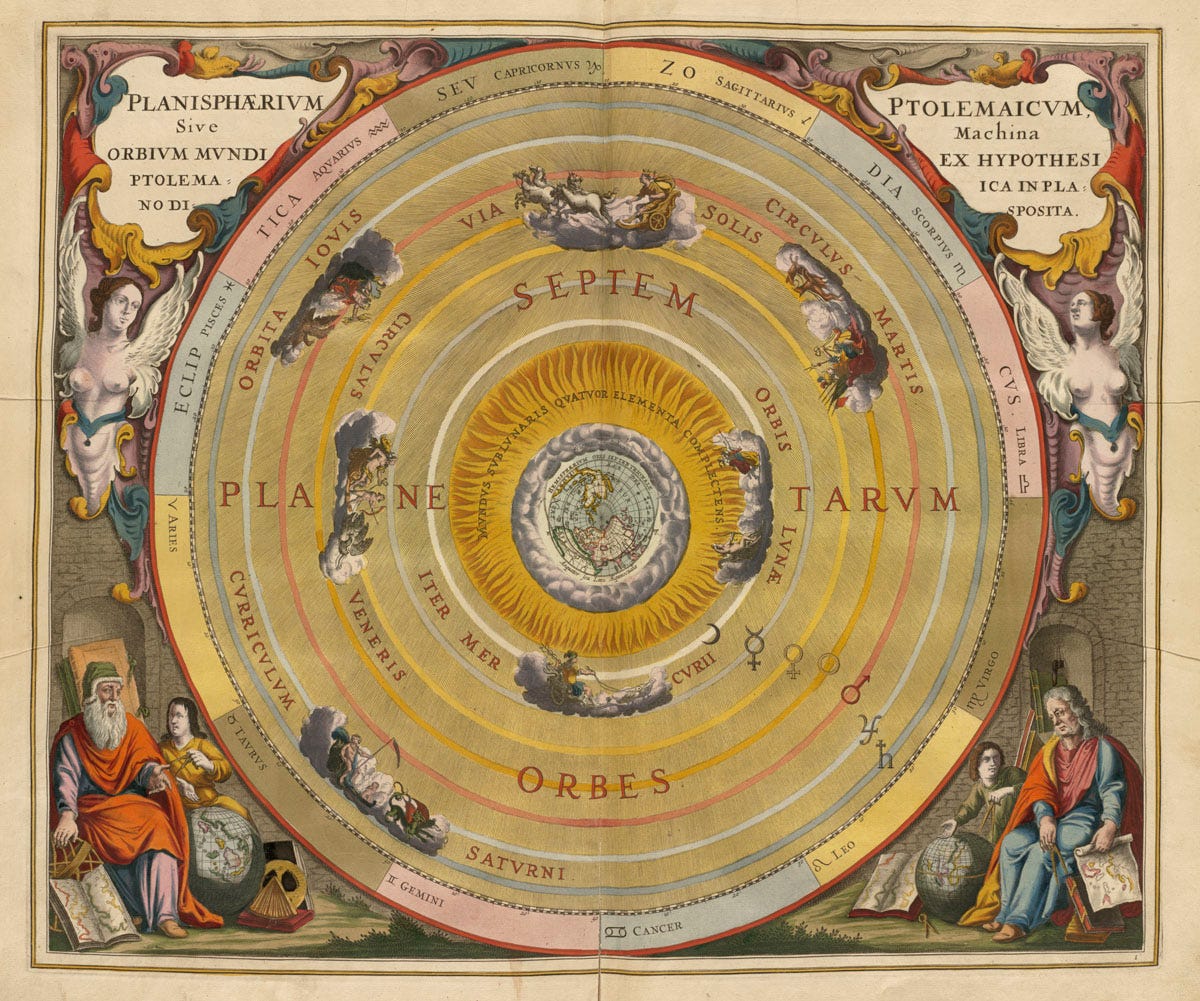
Plato inherited the claim and gave it its first thorough philosophical treatment. In the Timaeus, the Demiurge fashions the world-soul out of the same ratios that produce a well-tuned octave, and fashions the human soul out of the same ratios again, so that a rightly ordered life is, quite literally, a life in tune with the world it inhabits, and sin is a kind of dissonance before it is ever a broken rule.3
Augustine worked clearly within this tradition but turned it inward. He spent his own first thirty years chasing, in succession, Manichaeism, Neoplatonism, and a career as a rhetorician, before he could really understand what ailed him. Having discovered himself in God the Holy Trinity, he exclaimed famously, “You have made us for yourself, and our heart is restless until it rests in you.”4 His “restlessness” was, of course, not a mood but the condition of an instrument built for one particular resonance and not yet sounding it. And the rest his soul sought, he ultimately came to understand, is given rather than seized. Grace is received and cannot be manufactured by force of will. Augustine called the healed condition tranquillitas ordinis, and defined peace itself in exactly those terms: “the peace of all things is the tranquillity of order.”5
Whereas he understood sin to be a kind of dissonance created by disordered love, Augustine came to understand peace in Christ as ordo amoris: “it seems to me that it is a brief but true definition of virtue to say, it is the order of love.”6 If we love lesser things above greater things, he warned, then the soul, still searching for its rest, only introduces new dissonance into a life built for harmony. He wrote an entire early treatise on the subject and titled it De Musica. It is no accident that the vocabulary of tuning is the one he uses again and again, for both the sickness and the cure.
Two centuries later, the Christian senator Boethius was awaiting his own execution when he wrote De Institutione Musicaa and helpfully distinguished between musica mundana (the inaudible harmony of the heavens), musica humana (the inner harmony of a soul rightly ordered to itself and to God), and musica instrumentalis (the audible music that only echoes the other two).7 In his Consolation of Philosophy, composed in that same cell, Boethius further developed the idea, explaining that “The love of God governeth both the land and the sea, and likewise commandeth the heaven, and keepeth the world in due order and good accord … O how happy were mankind if this love that ruleth heaven might rule and govern their minds.”8 Whereas the Greek Pythagoras had recognized a natural law preceding and governing the world, the early Christians saw clearly that this law is none other than Jesus Christ – the eternal Logos – whose essence is love (1 John 4:8).9
You do not need to adopt Pythagorean number mysticism to follow the argument here. Notice what these thinkers agree on across sixteen centuries. They treat order as something given to the world before any human hand has shaped it. Being rightly related to that order distinguishes a harmonious life from a dissonant one.
Dante Alighieri wrote of the whole created order that “all things, among themselves, possess an order, and this order is the form that makes the universe like God.”10 Centuries later, the most celebrated of Anglican tehologians, Richard Hooker, wrote that “of Law there can be no less acknowledged, than that her seat is the bosom of God, her voice the harmony of the world,” so that “all things in heaven and earth do her homage,” each according to its own rank, “admiring her as the mother of their peace and joy.”11
This is how Christians understood the cosmos they inhabited for the better part of two thousand years. It was not an indifferent void scattered with matter, but a piece of music already being played, in which every creature, human and angelic, held a part and a place. C.S. Lewis, who spent his scholarly life inside that older cosmos before he spent his popular life defending it, called it an object “in which the mind can rest, overwhelming in its greatness but satisfying in its harmony.”12 His most important historical work on the subject is titled, The Discarded Image, but all of his works whether theological, literary, or apologetic – were meant to restore for the church its powerful vision of harmonious union between divine and human things.
The universe that replaced the ancient and discarded one is cold, vast and empty, and it feels more like a machine than a home. It gives no life, because nothing in it breathes, and it assigns no purpose, because it runs on blind law and has no meaningful end. There is no place for us in this universe, because nowhere in its architecture does human life have lasting meaning. It does not “sing” you might say, and neither do we. The modern person in the modern universe has to build his or her own “order” out of nothing, because this world has “lost its story,” and left us with a confused and tired mess.13
Someone has to stand in that gap and answer the world’s disorder with an “order” that they did not invent, which can only be received and shared. That is the priestly office in its most basic form.
In "Providence," from The Temple (1633), the Anglican poet priest, George Herbert, casts man as the priest of creation, charged with gathering its harmony into speech:
Man is the worlds high Priest: he doth present
The sacrifice for all …
The beasts say, Eat me: but, if beasts must teach,
The tongue is yours to eat, but mine to praise.
… all must appeare,
And be disposd, and dressd, and tund by thee,
Who sweetly temperst all. If we could heare
Thy skill and art, what musick would it be!
Herbert’s biblical insight is extraordinary and captures this essay’s argument perfectly. Creation, he writes, is “disposd, and dressd, and tund” by God, and man is ordained to gather that mute music into speech.
A priest does this in a multitude of ways, such as when the gospel is spoken aloud in places it has never been spoken, and a new Christian’s vision of herself and the whole world is transformed so that she is able to say, like C.S. Lewis:
I believe in Christianity as I believe that the sun has risen, not only because I see it but because by it I see everything else.14
A priest is called from within a disharmonious and disordered world to hear and perceive and articulate that ordered reality which precedes us and which has been revealed in Jesus Christ, the one “through whom are all things and through whom we exist” (1 Corinthians 8:6). The priest can do this only because Christ has already spoken that word into him and, by the Holy Spirit, speaks through him.
This is the vocation that God gave first to Adam in Eden whose priesthood failed. But Christ, the Last Adam, fulfilled it where Adam sinned, ..sharing his priesthood with the whole baptized Church, who now constitute a royal priesthood in him (1 Peter 2:9), and setting some apart from within that priesthood for ordained ministry that remains proximate to his own and is never independent of it. I have made that biblical case at length in a previous essay, and will not repeat it here. The voice of the priest is tuned to a music none of us composed and belongs to the deep structure of reality at all only because it is Christ’s own priesthood, lent to ordinary men who did not write the score.
And here is the point. Holy Orders is not a consolation-prize vocation for Christians who were not ambitious enough for something else. The priestly vocation is an honorable, good, feasible, and necessary part of God’s work in restoring harmony to a fallen and disharmonious world.
Conclusion: Ordered By Love
“Order” does not have to sound like paperwork, since it did not sound that way to the first Christians who made such good use of it. It suggested a rank within an army, or a station granted so that a person might receive something from God and pass it on to others. Moreover, it bore metaphysical weight as it signified the whole architecture of reality in which every rank, human and angelic, holds its place by grace and not by ambition.
If the priest has a part to play in that architecture, it is to help restore, in some small and derivative way, the order this essay has tried to describe. The priest is meant to be one of the instruments through which creation’s mute music finds its way back into speech. Through Word and Sacrament, the priest gathers and orders the congregation around Jesus Christ, who composes the piece still being played. But an instrument out of tune serves no one, however skillfully it is played. St. Paul employed exactly this image when he warned that the most eloquent ministry, offered without love, comes to nothing. Paul writes “If I speak in the tongues of men or of angels, but do not have love, I am only a resounding gong or a clanging cymbal” (1 Corinthians 13:1, NIV).
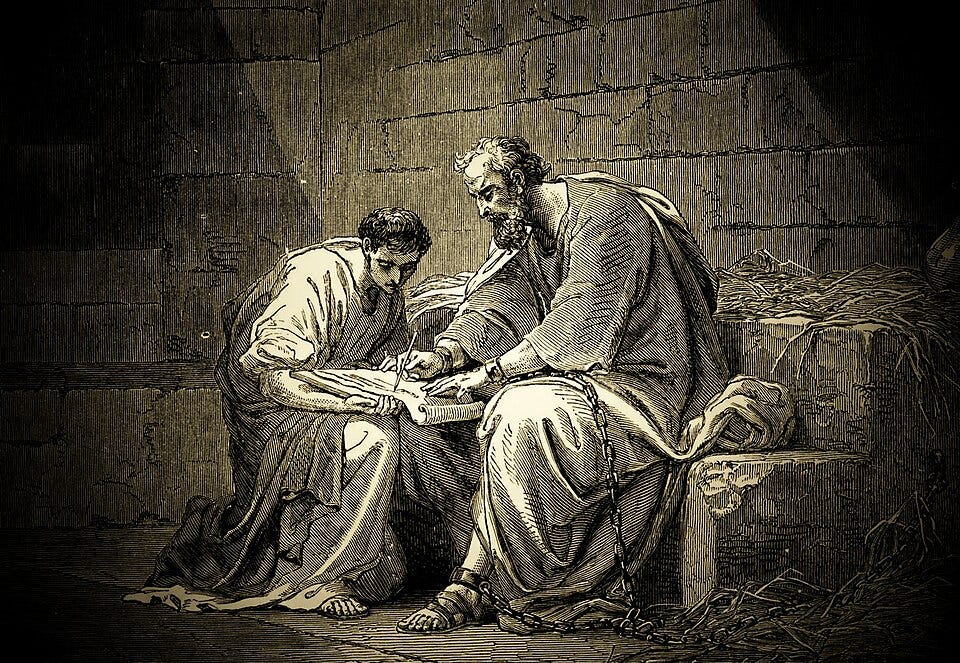
Paul makes this connection between order, harmony, and love centuries before Augustine describes tranquillitas ordinis or Boethius distinguishes musica mundana from musica humana. Having spent chapter thirteen defining love in the vocabulary of music, in the very next chapter he turns explicitly to the vocabulary of order, insisting that “God is not a God of confusion but of peace... all things should be done decently and in order” (1 Corinthians 14:33, 40). Paul addresses love first and order second, because love (rightly understood) is the ordering power. Writing elsewhere of Christ, he makes the same claim on a cosmic scale, declaring that “He is the image of the invisible God, the firstborn of all creation. For by him all things were created, in heaven and on earth, visible and invisible, whether thrones or dominions or rulers or authorities—all things were created through him and for him. And he is before all things, and in him all things hold together (Colossians 1:15-17).
And Paul himself was not the first in Scripture to identify the givenness of creation with music. When God finally answers Job out of the whirlwind, he grounds creation itself in music, asking him, “Where were you when I laid the foundation of the earth?... when the morning stars sang together and all the sons of God shouted for joy?” (Job 38:4, 7). The Psalmist makes the same claim about creation’s ongoing praise, writing that “the heavens declare the glory of God, and the sky above proclaims his handiwork... There is no speech, nor are there words, whose voice is not heard. Their voice goes out through all the earth” (Psalm 19:1, 3-4). This is Herbert’s whole argument, already sung centuries before he put it into verse. Creation offers real, wordless praise, and it takes a human voice to gather that praise into speech. THAT is the priestly vocation given at creation to all mankind.
Notice, too, how Paul describes a loveless minister. Describing himself, he says that, without love, he would nothing more than noise, plain and simple. Like Job, the Psalmist, and Pythagoras before him, and like Augustine, Boethius and so many to come after, Paul reaches instinctively for the vocabulary of harmony to describe what love is and what its absence produces. It is a different and worse kind of sound than silence. Sung among a chorus of fallen and rebellious creatures, it is as Tolkien writes in the Silmarillion, “loud, and vain, and endlessly repeated,” achieving “little harmony, but rather a clamorous unison as of many trumpets braying upon a few notes.”15
A priest can hold every credential and still be, in Paul’s own words, nothing but a “resounding gong.” Holy Orders confers the office, but love is requisite for abiding in God (John 15:9-10) and thus brings every ministry into harmony.16 Holy Orders, understood this way, is a harder and larger life than the church often imagines. It involves a real battle fought on contested ground for the highest stakes imaginable. But it is also a graced calling in service to a King who has already won the decisive battle. He calls us simply to keep playing our part, restoring what harmony we can, until he returns and finally sets the whole piece in order.
The document is 1 Clement, written from Rome to the church at Corinth around the year 96, after Corinth had deposed its own presbyters. Clement writes, “Let us mark the soldiers that are enlisted under our rulers, how exactly, how readily, how submissively, they execute the orders given them… each man in his own rank executeth the orders given by the king and the governors” (1 Clement 37:2–3, trans. Lightfoot). His word for “rank” there is tagma, a Greek military term for a unit or division, chosen because he means the comparison as literally as he can manage. Four chapters later he applies the identical word, tagma, to every believer rather than only the ordained, after first fusing the military picture with the Old Testament cult: “to the high priest his proper services have been assigned, and to the priests their proper office is appointed, and upon the levites their proper ministrations are laid. The layman is bound by the layman’s ordinances” (40:5), followed immediately by, “Let each of you, brethren, in his own order give thanks unto God” (41:1). “Order” here translates the identical Greek word rendered “rank” three chapters earlier. Notably, this is the first known instance of “order” language applied to Christian ministry, and it arrives already dressed in the discipline of the Roman army. A contemporary current ran the other way. Writing perhaps a decade later, Ignatius of Antioch describes the same threefold ministry not in the language of rank at all but of icon, the bishop presiding “after the likeness of God” and the presbyters “after the likeness of the council of the Apostles” (To the Magnesians 6.1, trans. Lightfoot). The church’s earliest reflection on its own ministry made use of both analogies at the same time – representation and rank, icon and army – long before it had settled on either. For further reading on early church order and ministry, see Hans von Campenhausen, Ecclesiastical Authority and Spiritual Power in the Church of the First Three Centuries, trans. J. A. Baker (London: A. & C. Black, 1969); Allen Brent, The Imperial Cult and the Development of Church Order (Leiden: Brill, 1999).
Aristotle, Metaphysics I.5, 985b23–986a3 (trans. Ross). Pythagoras’s school sealed this conviction with an oath sworn “by him who gave to us the tetractys, the fount and root of ever-flowing nature” (Sextus Empiricus, Adversus MathematicosVII.94–95).
Timaeus 30a; cf. 47d, 92b. Plato describes the pre-cosmic state as moving plēmmelōs — literally “unmusical” or “off-key” – before the Demiurge brings it into order, making dissonance, quite literally, the Greek word for disorder.
Augustine, Confessions I.1 (trans. Chadwick).
Augustine, City of God XIX.13 (trans. Dods).
Augustine, City of God XV.22 (trans. Dods).
Boethius, De Institutione Musica, Book I, chs. 1–2 (trans. Bower). Medieval and early modern writers after Boethius simply assumed this threefold distinction.
Boethius, Consolation of Philosophy II.m.8 (Tudor translation).
The Stoics had already absorbed the Pythagorean-Platonic inheritance into their physics, teaching that the cosmos is a single rationally governed whole bound by a logos that is at once reason, law, and, in writers such as Cicero, a “celestial regency” and “mind of the world”; their idea of a cosmic sympatheia – a world tuned to itself in every part – preserves the older musical language. Developing ideas already nascent in Philo and other Jewish writers, John’s Gospel makes the boldest move in the tradition, suggesting that this ordering Logos “became flesh and dwelt among us” (John 1:1, 14).
Dante, Paradiso I.103–111 (trans. Singleton).
Hooker, Of the Laws of Ecclesiastical Polity I.xvi.8.
C.S. Lewis, The Discarded Image (Cambridge University Press, 1964), 99. Likewise, C.S. Lewis carries on the great harmony tradition in the twentieth century, discursively, in The Abolition of Man, where a civilization’s rejection of objective value produces “men without chests,” or people whose affections are no longer rightly tuned to their objects (ch. 1); and imaginatively, in The Magician’s Nephew, where Aslan sings Narnia into being and an ordinary onlooker says, on hearing it,”Glory be! I’d ha’ been a better man all my life if I’d known there were things like this” (ch. 8).
Robert W. Jenson, “How the World Lost Its Story,” First Things, October 1993.
C.S. Lewis, "Is Theology Poetry?" in The Weight of Glory and Other Addresses, rev. ed. (San Francisco: HarperOne, 2001), 140.
The Silmarillion opens with the Ainulindalë, the Music of the Ainur, in which even Melkor's rebellious discord is folded back into a harmony he cannot finally escape, as Eru Ilúvatar tells him, "no theme may be played that hath not its uttermost source in me, nor can any alter the music in my despite" (ed. Christopher Tolkien, "Ainulindalë"). For further reading on the harmonic-cosmos tradition generally, see Joscelyn Godwin, Harmonies of Heaven and Earth (1987); Penelope Gouk, Music, Science and Natural Magic in Seventeenth-Century England (New Haven: Yale University Press, 1999).
Thanks to Fr. Ron Offringa for drawing my attention to this from Ignatius’s “Epistle to the Ephesians”: “Wherefore it is fitting that you should run together in accordance with the will of your bishop, which thing also you do. For your justly renowned presbytery, worthy of God, is fitted as exactly to the bishop as the strings are to the harp. Therefore in your concord and harmonious love, Jesus Christ is sung. And man by man, become a choir, that being harmonious in love, and taking up the song of God in unison, you may with one voice sing to the Father through Jesus Christ, so that He may both hear you, and perceive by your works that you are indeed the members of His Son” (Ign. Eph. 4).
Thanks for writing this, Dr. Hollon. I appreciated when you said: “Truth and beauty and goodness precede us, so that our part is to apprehend, appreciate, and conform ourselves to what we receive.” One of the sad consequences of “re-enchantment” efforts is that it makes the world sound dull, lifeless, and disordered, and some magician has to come around to turn lead into gold. What you’re saying here sounds like the world hasn’t lost its order and wisdom, and our “orders” are a reflection of God’s good order. Malcolm Guite says our work is to un-disenchant ourselves so we can see the wisdom of God’s order and respond to it properly again.
This is a remarkable tapestry you reveal here. It is very encouraging to read this as an Anglican of a younger generation. A couple of things connect with what I have been mulling over in recent years. The call to Holy Orders as ambitious in a sense reminds me of how so many of the greatest Church Fathers of the Fourth Century left the most elite secular careers to take up ministry: Ambrose was a provincial Governor from a very well-connected family, Augustine was a professional rhetorician, Augustine's friends who influenced his conversion were previously members of the Caesar's household, the Cappadocian Fathers all had elite Imperial careers waiting for them. These men dropped it all, sold properties and estates, and embraced a certain level of poverty because of the transforming power of Jesus, Paul, and, interestingly in many cases, Athahasius's presentation of Antony the Great (Confessions, Bk VIII).